

You can stop a poor performer from dragging your whole team down, and you can start this week. The best leaders treat honest feedback as a gift, not an attack, and they deliver it early, before the damage spreads. That one shift keeps your top people from walking out the door and gives the struggling employee a real shot to turn things around.
Here is the thing. After 20 years of speaking to Fortune 500 teams like Coca-Cola, Aflac, and the US Army, I see the same pattern in every room. The leaders who avoid hard conversations lose their best people within six months. The ones who speak up with clarity and respect keep their teams tight and their numbers up.
You and I know the person on your team right now. The one who coasts while everyone else carries the load. I am going to show you how to figure out what is really going on, have the conversation with honesty and care, build a plan that works, and follow through.
Table of Contents
- What Is Poor Performance and Why Does It Spread So Fast?
- How to Address Poor Performance Using the ALBIA Method
- What You Get When You Address Poor Performance Early
- How to Build a Performance Improvement Plan That Works
- How to Make the Call When Performance Does Not Improve
- Bringing Honest Feedback to Life Every Day
- Frequently Asked Questions
What Is Poor Performance and Why Does It Spread So Fast?
Poor performance is a pattern of falling short, not a single mistake or a bad day. It spreads because your top people watch how you respond. When nothing changes, they lose faith in you. And they start quietly planning their exit.
The Difference Between a Mistake and a Pattern
A mistake is a one-time slip that usually teaches something. A pattern is missed deadlines week after week, work that needs constant fixes, and attitude problems that pull others down with them.
Here is what I know for sure: mistakes are opportunities. Every strong leader should welcome them. Without mistakes, there is no learning and no creativity. But a pattern is something else. It is a signal that something deeper is going on, and that something needs your attention.
Why Ignoring Poor Performance Makes It Worse
Every day you wait to act, the problem grows. Your best people wonder why they work so hard while the slacker skates by. Morale drops. Productivity drops. And your top talent starts updating their resume.
Sound familiar? I have seen this play out in departments at Marriott, in sales teams at Verizon Wireless, and in government offices around the country. The silence of the leader almost always gets read by the team as approval. That is why speaking up early matters so much. For more on this, see my thoughts on leading through change and pressure.
Skill, Will, or Environment: The Three Root Causes
Every case of poor performance traces back to one of three root causes: skill, will, or environment. Before you have the conversation, figure out which one you are dealing with.
A skill problem means the person does not know how to do the job. They need training or better tools. A will problem means they have checked out or lost interest. That is a different conversation entirely. An environment problem means something in the workplace is making it impossible for them to succeed, and that one might be on you to fix.
Ask yourself those three questions before you say a word. The answer changes everything about how you show up in the meeting.
How to Address Poor Performance Using the ALBIA Method
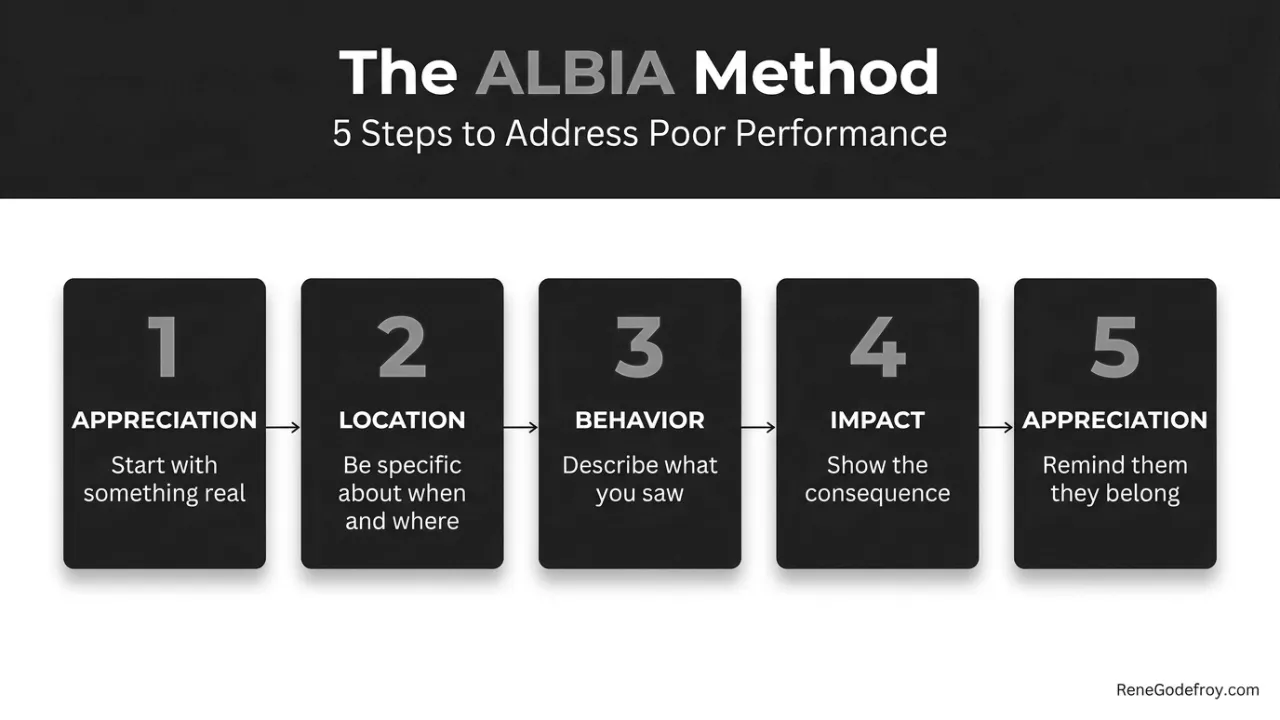
The ALBIA Method is a five-step conversation framework I teach to managers at Fortune 500 companies and government agencies. It stands for Appreciation, Location, Behavior, Impact, and Appreciation again. It works because it keeps the conversation honest without making the person feel cornered.
Step 1: Appreciation (Start With Something Real)
Open with something genuine you value about this person. Not flattery. Not fluff. Something real. “I value how prepared you always are for client meetings.” When people feel seen, they stay open. When they feel ambushed, they shut down.
Step 2: Location (Be Specific About When and Where)
Anchor the conversation to a specific time and place. “In last week’s team meeting…” or “On the Thursday report…” Vague feedback feels like an attack. Specific feedback feels like a fact. And facts are a lot easier to talk about than feelings.
Step 3: Behavior (Describe What You Saw, Not What You Felt)
Stick to what you observed, like a camera would. “You interrupted Sarah three times while she was presenting.” Do not guess at motives. Do not assign feelings. Describe the behavior and nothing more. That keeps the conversation out of the “you always” and “you never” territory that kills trust.
Step 4: Impact (Show the Consequence)
Connect the behavior to what happened as a result. “…and it made others hesitant to share their ideas.” People rarely see the ripple effect of their own actions. Your job is to show them.
After you name the impact, stop talking. Ask one simple question: “Can you help me understand what was going on?” Then listen. Really listen. This is where the real conversation begins.
Step 5: Appreciation Again (Remind Them They Belong)
Close with a second note of appreciation. “I know that is not who you are. I am bringing this up because I believe in you.” That final line sends them away knowing you are not attacking them. You are redirecting them. Big difference.
One more tip. When you mention the behavior, never point or gesture at them. Point away. You want to separate the person from the behavior. That small move tells them, on a deeper level, they are not the problem. The behavior is.
What You Get When You Address Poor Performance Early
When you step into these conversations instead of avoiding them, your whole team changes. Honest leaders build honest teams. People stop guessing where they stand. And they start trusting the room they work in.
Your Top Performers Stop Leaving
Your best people do not leave because the work is hard. They leave because they watch leaders tolerate low standards. When you address poor performance early, you send a message to everyone: this is a place where what you do matters. According to Gallup’s State of the Global Workplace report, teams with engaged, accountable cultures have dramatically lower turnover. That is how you keep the best and brightest.
Morale and Trust Come Back
A team that watches its leader handle hard conversations with respect starts to believe in the leader again. Trust is not built by avoiding discomfort. It is built by stepping into it with care. You may be surprised how fast morale lifts once people see you doing the hard thing well. If you want to go deeper on this, I wrote about building resilient teams last month.
The Struggling Employee Gets a Real Shot
Here is what most managers miss. The person who is struggling usually does not know how bad it has gotten. They are not trying to fail. They are drifting. An honest conversation is often the exact wake-up call they needed, and many of them turn it around completely. No condition is permanent. Even a track record of poor performance can shift with the right support.
How to Build a Performance Improvement Plan That Actually Works
A performance improvement plan is not paperwork. It is a written agreement that says, “Here is what needs to change, here is how I will support you, and here is what happens if things do not improve.” Done right, it gives them clarity and gives you a fair path forward.
Clear Goals and Standards
Write down exactly what “good” looks like. Not fuzzy. Not vague. “Submit all reports on time with zero errors for the next 30 days.” If the standard is not written down, you cannot hold anyone to it. Clarity is king.
Real Support, Not Just Paperwork
What will you provide? Training? Coaching? Regular check-ins? A mentor? A plan with no support is a setup for failure. If you really want the person to succeed, give them the tools they need and be there to coach them through it.
Follow-Up and Coaching
The plan means nothing if you do not follow through. Schedule weekly check-ins. Ask real questions. Help them think through problems. That is coaching.
Do not confuse coaching with micromanaging. Coaching asks, “What is getting in your way?” Micromanaging hovers over every click of the mouse. One builds people up. The other tears them down. You know the difference. Am I right?
Here is a case study. A sales manager at Aflac worked with one of his reps for six months using the ALBIA process. The rep had been missing quota for three quarters in a row. After the fourth honest conversation, they figured out together that the rep was in the wrong market, not the wrong career. The manager helped him transfer to a different territory. Within two quarters, the rep was a top producer.
How to Make the Call When Performance Does Not Improve
Sometimes, despite everything you do, performance does not improve. That is when you have to make the hard decision. And I will be honest with you: it does not get easier with practice. But it is part of the job.
When to Move On
If you have had the honest conversation, built the plan, offered the support, and followed up consistently, and the work still is not there, it is time. Document everything. Work with HR. Make sure the file is clean and fair.
Before you let them go, ask one more question: is there a different role where they might thrive? Some people are not bad employees. They are in the wrong seat. That is not a character flaw. That is a misalignment.
How to Let Someone Go With Dignity
When it is time, be honest and be kind. “This is not personal. I want you to succeed. Just because this role is not your fit does not mean you are not brilliant. It just means this is not where you belong.” If you can, help them find their next step. That is real leadership.
Letting someone go can actually be the kindest thing you do. It frees them to find a place where they can succeed. Where they fit. Where they shine.
Bringing Honest Feedback to Life Every Day
Let me tell you a quick story. The night before I spoke at the Indiana Bankers Association, I nearly walked off the job. I had checked into the hotel, wandered into the empty ballroom, and saw my name and face on signs stretched across the room. That is when the voice started. “Who do you think you are? These are bankers. You opened doors for a living for 14 years. You came to this country with $5, two shirts, and one pair of pants.”
I called my brother-in-law. He is the one person in my life who tells me what I need to hear, not what I want to hear. He asked me, “Rene, did they invite Les Brown? Did they invite Tony Robbins? No. They called you. There is a reason. You are the only qualified person on earth to stand there tomorrow.” That is what honest feedback does. It does not tear you down. It points you to the truth.
The next morning I walked on that stage with no shaking knees, and they gave me a standing ovation. That is what one honest conversation can do for a person. That is what your honest conversation can do for the employee sitting across from you this week. No condition is permanent. Keep stepping.
Frequently Asked Questions
How do I start a conversation about poor performance without making it worse?
Start with something real you appreciate about the person, then move to specific facts about what you saw and when. Use the ALBIA Method as your guide: Appreciation, Location, Behavior, Impact, Appreciation again. Ending with a second note of appreciation makes sure they leave knowing you still believe in them.
What are the three root causes of poor performance at work?
Poor performance usually comes from one of three root causes: a skill gap, a will problem, or an environment issue. A skill gap means training is needed. A will problem means motivation or engagement has dropped. An environment issue means something in the workplace is blocking their success, and that one might be on you to fix.
How long should a performance improvement plan last?
Most performance improvement plans run 30 to 90 days, depending on how complex the role is and what needs to change. Set clear milestones along the way so both of you can track progress week by week. Short, focused plans usually work better than long, vague ones.
What if my employee gets defensive during the conversation?
Stay calm and stay kind. Defensive reactions usually mean they feel attacked, not that they disagree with the facts. Lower your voice, slow your pace, and ask, “Can you help me understand what was going on?” That simple question often shifts the whole tone of the meeting.
When is it time to let a poor performer go?
If you have had the honest conversation, built the plan, offered real support, and followed up consistently, and performance still has not improved, it is time to make the call. Document everything and work closely with HR. Consider whether a different role inside the company might fit them better before letting them go.
Why does ignoring poor performance hurt my best employees?
Your top people watch how you respond to low standards on the team. When nothing happens, they lose trust in you and start planning their exit. Addressing poor performance early tells your best performers that their hard work matters. That is how you keep them engaged and keep them around.



0 Comments