
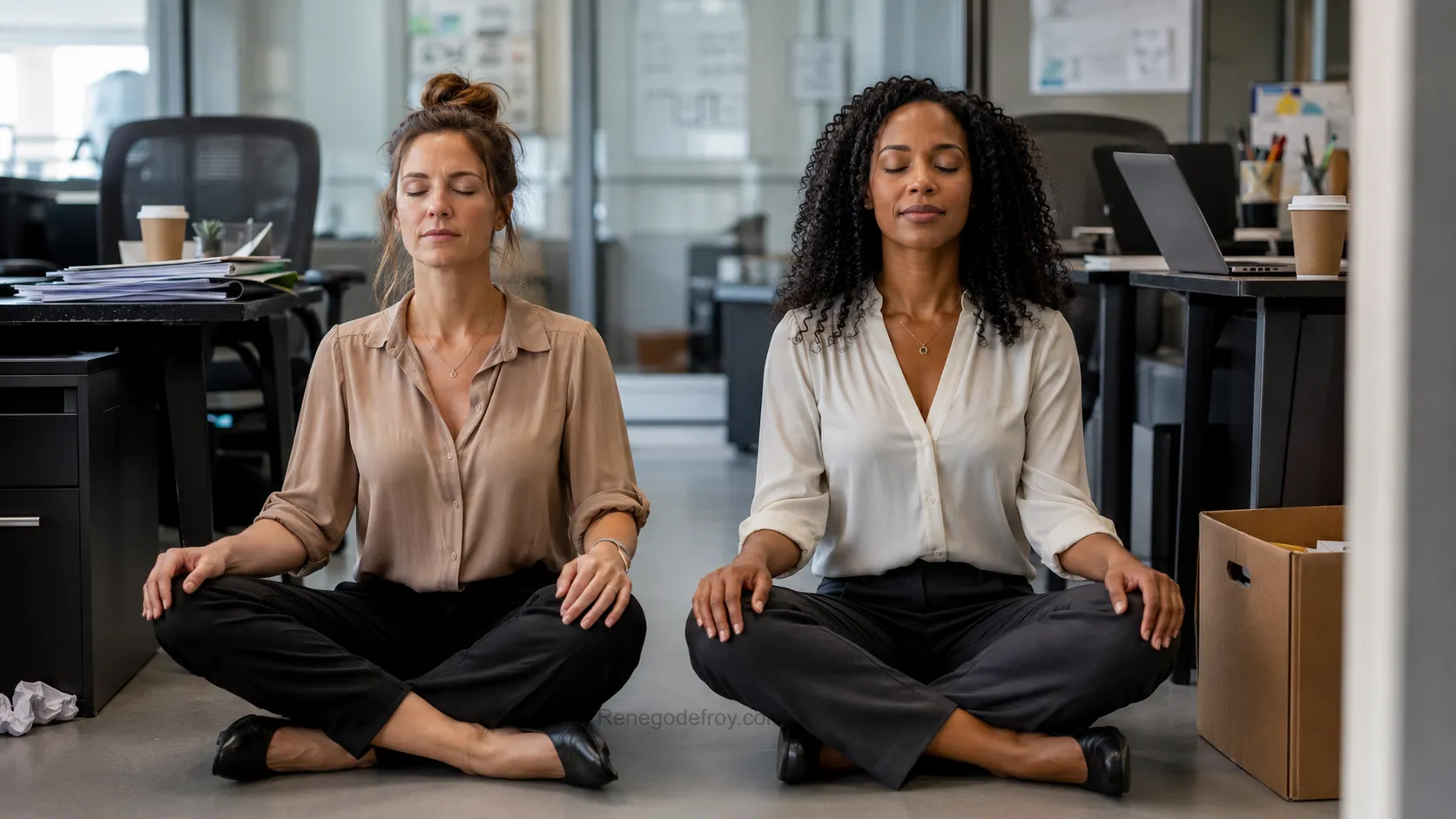
Your mind will not slow down. The workday ended an hour ago, but your head is still at the office. The unread emails. The deadline. That one comment you keep replaying. If your thoughts race like that, meditation for work stress may be the most useful skill nobody ever taught you.
I learned it the hard way, and it changed how I think, lead, and rest. So let me share what works for me.
Here is what stress does when you let it run loose. It clouds your thinking. It shortens your patience. It turns small problems into mountains. You snap at people you love. You lie awake at 2 a.m. doing math that could wait until morning. Over time, that pressure does not just tire you out. It hollows you out.
That hollow feeling has a name. Burnout. Gallup found that most full time workers feel burned out at work at least sometimes. It shows up as exhaustion that sleep does not fix. It shows up as a cold “I do not care anymore” about work you used to love. It shows up as good people doing average work, wondering where their spark went. Maybe you have felt one of those. I have too.
Here is the truth. You cannot out work this. Working harder is like pouring gas on a fire and hoping it goes out. The fix is not more effort. The fix is learning to find quiet on purpose.
Some of the busiest minds on earth do exactly that. Oprah Winfrey. Ray Dalio, who built one of the biggest investment firms in the world. Marc Benioff, who runs Salesforce. Bill Gates took it up and wrote about it. If people carrying that much weight choose to sit still, maybe there is something to it.
For me, the quiet runs deeper than focus. There is an old line about seeking first the kingdom within, and the rest gets added to you. Most of us do the opposite. We chase everything out there and rarely sit still long enough to find the calm in here. Meditation is how I go in. You do not have to share my faith to use it. You just have to be willing to sit down and breathe.
The Calm Is Already in You
People tell me all the time, “Rene, I cannot quiet my mind. I tried. It does not work for me.”
I get it. But here is something most people miss. Calm is not something you build. It is something you uncover.
Think about it. In your mother’s womb, you were peaceful. In deep sleep, your mind and body go completely still. The quiet was never gone. It just got buried under noise.
Calm is not something you build. It is something you uncover.
Picture the ocean. On the surface, the wind whips it into a frenzy. Waves crash and fight each other. It looks like pure chaos. But dive down deep, and it is still. No noise. No fighting. Just peace.
Your mind works the same way. The racing thoughts live on the surface. Deep underneath, there is a calm place that never left. The goal of meditation is to get down there. And the good news is, you already know the way. You just forgot it.
3 Steps to Practice Meditation for Work Stress
Let me show you what works for me. This is the same practice I use before I walk on a stage in front of thousands of people. Three steps. That is it. No app required. No special cushion. Just you and your breath.
1-Dive Below the Noise
Sit comfortably and let your whole body relax. Drop your shoulders. Unclench your jaw. You are not performing. You are just sitting.
Now bring your attention to your breath. Feel the air come in through your nose. Feel it fill your lungs. Do not force it. The breath is already there, waiting for you. You only have to notice it.
As you breathe, picture yourself sinking. The thoughts keep making noise up above. Let them. You are heading down to the still water, below all of it. Every slow breath takes you a little deeper.
Try this today. Sit for five minutes and do nothing but feel your breath go in and out. That is the whole job. Five minutes. You can do five minutes.
2-Stop Fighting Your Thoughts
Here is the mistake almost everyone makes. They try to force the thoughts to stop. That is like trying to flatten the waves with your hands. The harder you fight, the worse it gets.
Do the opposite instead. When a thought shows up, do not wrestle it. Welcome it. Say to yourself, “Here is another one.” Then let it float by.
Watch what happens. The moment you notice a thought, it loses its grip. It fades. You did not push it out. You just stopped feeding it.
The moment you notice a thought, it loses its grip.
Try this today. Next time a worry pops up during your sit, name it. “Here is another one.” Then come back to your breath. No fight. Just notice and return.
3-Breathe in a Rhythm and Start Small
Once you feel relaxed and settled, give your breath a beat. In. Hold. Out. Breathe in slow. Hold it for a second. Release without pushing.
Say the words in your head as you go. “In. Hold. Out.” Let it become a steady rhythm, like a soft drum. Your brain loves rhythm. It will follow the beat and slow down with it.
Here is the part people get wrong. They try to start with a full hour and quit by day three. Do not do that. Start with fifteen minutes. Same time. Same spot. Every day.
I meditate for a full hour now. But it did not start that way. And funny thing, that hour feels like fifteen minutes to me. The peace is that deep. You get there one short session at a time.
Start with fifteen minutes. Same time. Same spot. Every day.
What This Does for You and Your Team
Maybe you lead a team. Then this matters even more. Your people read you. When you walk in tense and short, they catch it. When you walk in calm and steady, they catch that too.
You cannot give your team what you do not have. A frazzled leader builds a frazzled team. A calm leader gives people room to think and breathe. That is how you protect them from burning out, and it starts with you. If you lead people, I wrote more on how to manage stress in the workplace as a leader.
It is never about the meditation. It is about the story of the meditation. A few quiet minutes each morning is not really about sitting still. It is about who you become for the people counting on you. Clear instead of scattered. Patient instead of snappy. Present instead of somewhere else.
Here is the truth most leaders learn too late. Your team does not need you to have every answer. They need you to stay steady when things get hard. Meditation is how you build that steadiness.
Questions People Ask About Meditation for Work Stress
What is the difference between stress and burnout?
Stress is short term. It comes, it spikes, and it passes once the deadline is done. Burnout is what happens when the stress never lets up. It is a slow drain that leaves you empty, cold about your work, and sure that nothing you do matters. Stress says, “This is a lot.” Burnout says, “I am done.” Meditation helps with both, but it works best when you start before you hit empty.
Can burnout be reversed, or is it permanent?
It can be reversed. I believe this with my whole heart. No condition is permanent. With rest, support, and small daily habits like meditation, people come back. The spark returns. It takes time and patience, the same way the practice does. But the door is never locked.
How long should I meditate for work stress?
Start with fifteen minutes a day. Pick the same time and the same place so it becomes a habit your body expects. If fifteen feels like too much at first, sit for five. The length matters less than showing up every day.
What if I really cannot quiet my mind?
Then you are normal. Nobody empties their mind. That is not the goal. The goal is to stop fighting the noise and sink below it. Welcome the thoughts. Watch them pass. Some days will feel calm. Some will feel busy. Both count. You are still building the muscle.
If your people are running on empty, a keynote on resilience can help them reset and find their footing again. That is what I bring to Fortune 500 stages. If your team needs this message, let’s talk.
Let me conclude by saying this. The world will not slow down for you. The emails will keep coming. The pressure will not ask permission. But you can build a quiet place inside that the noise cannot reach. The ocean stays wild on top. You learn to live down deep where it is calm.
There you have it. A simple practice that can change how you work, lead, and rest. Sit down. Breathe. Sink below the noise. It is already in you.
Much success to you! Press on!



0 Comments